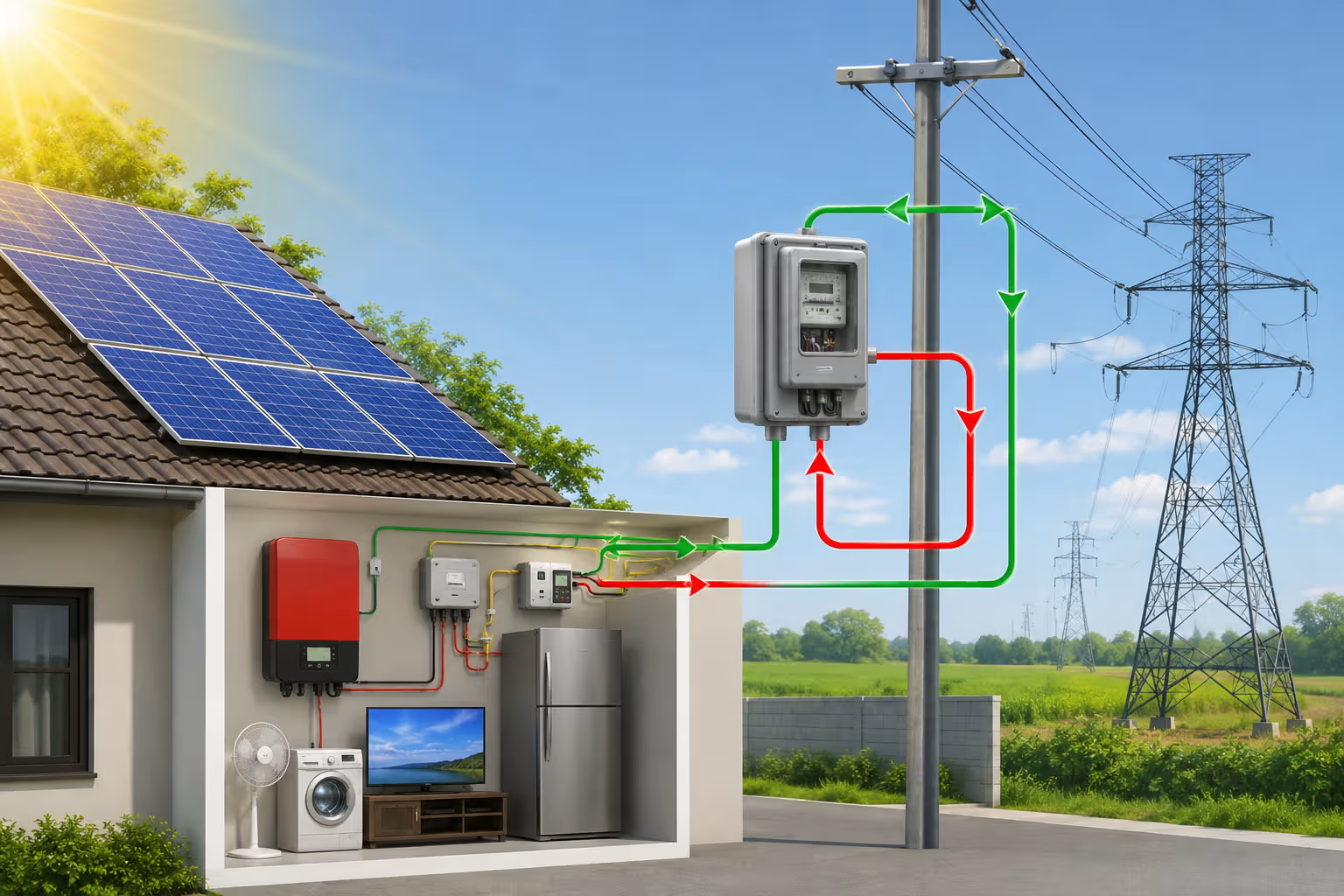
Solar net metering is a billing system that lets your rooftop solar panels and the electricity grid work together. It uses a two-way bidirectional meter that records two things: the units your system sends to the grid, called export, and the units you draw from the grid, called import.
At the end of your billing cycle, you are charged only for the net difference between the two. Your panels make the most power in the daytime, often more than your home uses, and net metering makes sure that extra power is not wasted. Instead, it is pushed to the grid and turned into credits that lower your bill.
This single feature is what makes rooftop solar truly pay off in India. In this guide, we explain what net metering is, how it works step by step, the difference between net, gross, and net billing, the benefits, the 2026 rules in India, and how to apply.
What Is Solar Net Metering?
Solar net metering is a billing arrangement between you and your electricity company, your DISCOM. When your solar system makes more power than you need, the surplus flows into the grid. When your system makes less than you need, like at night, you pull power back from the grid.
A special two-way meter keeps count of both. You pay only for your net use, which is the power you imported minus the power you exported.
In short, the grid acts like a giant battery for your home. You store extra units in it by day and take them back later, without buying any costly batteries.
How Does Solar Net Metering Work?
Let's break it down in simple steps.
Step by Step, Day and Night
-
Daytime: Your panels make power. Your home uses what it needs first.
-
Surplus is exported: Any extra power your home does not use is sent to the grid. The net meter counts these export units, and you earn credits.
-
Night or cloudy hours: Your panels make little or no power, so your home draws units from the grid as usual. The meter counts these import units.
-
Billing cycle ends: The DISCOM looks at your total imports and total exports, and bills you only on the net amount. If you exported more than you imported, the extra credits usually carry forward to your next bill.
What Is a Net Meter?
A net meter is a smart, two-way meter that the DISCOM installs in place of your old one. A normal meter counts power flowing only one way, into your home. A net meter counts power flowing both ways, into your home and out to the grid.
This is the device that makes the whole net metering system possible.
A smart meter reader helps track these import and export units more accurately, which is why the meter plays such an important role in rooftop solar billing.
A Simple Example of Solar Net Metering
Say in one month your solar system sends 300 units to the grid during the day. At night and on cloudy days, your home pulls 200 units back from the grid.
| Particulars | Units |
|---|---|
| Units exported | 300 |
| Units imported | 200 |
| Net result | 100 extra units exported |
So for that month you pay nothing for energy, only small fixed charges, and the extra 100 units carry forward as credit to your next bill.
This is exactly how net metering keeps cutting your bill, month after month.
Net Metering vs Gross Metering vs Net Billing
These three models are often confused, but they work very differently. Here is a simple comparison.
| Feature | Net Metering | Gross Metering | Net Billing |
|---|---|---|---|
| What happens to your power | You use it first, export only the surplus | You export 100% of it to the grid | You use it first, export the surplus |
| How you are paid | Credits at the retail tariff, the rate you pay | A fixed feed-in rate for all units sold | Credits at a lower export rate, not full retail |
| What you buy | Only the net units you need | All your home's power separately | All imported units at the retail rate |
| Best for | Homes and small businesses | Large or commercial setups | Where state policy sets a separate export rate |
Did you know? For most Indian homes, net metering gives the best savings. That is because your export credits are valued at the retail tariff, which is higher than the rate a DISCOM usually pays under gross or net billing.
Benefits of Solar Net Metering
Net metering is the reason rooftop solar makes such strong financial sense.
Big Bill Savings
Most solar homes cut their electricity bill by 70 to 90%, and a well-sized system can bring it close to zero.
In cities where electricity bills are rising in Indore, net metering can make rooftop solar even more useful for long-term savings.
No Costly Battery Needed
The grid works as your free virtual battery, so you do not have to spend lakhs on battery storage.
Faster Payback and Better ROI
Because no power is wasted, you recover your investment faster, usually in 3 to 5 years.
Protection From Rising Bills
Electricity tariffs in India rise by about 5 to 7% every year. Net metering shields you from these hikes.
Surplus Carries Forward
Extra units you do not use are not lost. They roll over to your next bill as credits.
Net Metering Rules and Eligibility in India (2026)
Net metering rules are set by each state's electricity commission and managed by your local DISCOM, so they vary a little from state to state.
Here is the current picture for 2026:
- Who can apply: Residential, commercial, and institutional consumers can all apply, as long as their system size and sanctioned load meet the rules.
- Capacity limit: As a central guideline, net metering is generally allowed for systems up to 500 kW or your sanctioned load, whichever is lower. Your home's solar size usually cannot be more than your sanctioned load.
- Faster approval for small systems: For rooftop systems up to 10 kW under the PM Surya Ghar Yojana, technical feasibility approval is treated as automatic, which speeds things up. Systems above 10 kW need a feasibility check.
- Needed for subsidy: An approved net-metering connection is required to claim the solar panel subsidy in India of up to ₹78,000.
Did you know? A draft national policy in 2026 has signalled that new, larger systems may move toward gross metering in the future, while existing net metering users would be protected, grandfathered. So applying now is a smart way to lock in net metering benefits.
How to Apply for Net Metering, Step by Step
Getting net metering is a clear, fixed process.
Here are the main steps:
- Check your DISCOM's rules for system size, fees, and documents in your state.
- Install an approved rooftop solar system using ALMM-listed panels.
- Apply to your DISCOM, or through the PM Surya Ghar National Portal, with your details, system size, and the fee.
- Get the feasibility check and inspection done by the DISCOM.
- Get the net meter installation and final approval, after which your system is connected to the grid.
In most states, this takes about 15 to 45 days when your papers are complete.
This is the part that feels confusing to many homeowners, and that is where Sunheaven makes it easy. Sunheaven handles the full journey for you, from sizing the right system and using approved panels to filing the net-metering application and the subsidy paperwork with your DISCOM.
The complete solar panel installation process in Indore also includes site survey, system design, approvals, installation, net meter setup, and final commissioning. You get connected and start saving without running around for approvals.
Cost of a Net Meter in India
There is no single fixed price for a net meter in India. The cost depends on your state, your DISCOM, whether your connection is single-phase or three-phase, and the type of meter used.
A single-phase net meter is cheaper, while a three-phase meter costs more. Some DISCOMs even bundle the meter cost into the connection or approval fee.
Always ask your DISCOM or installer for the exact, current charge in your area so there are no surprises.
The final cost of going solar also depends on your system size. Small homes may compare the 3 kW solar system price in India, while medium homes with higher monthly usage may find the 4 kW solar panel price in India or 5 kW solar system price in India more relevant.
Conclusion
Net metering is what turns rooftop solar from a good idea into a smart investment. By counting the power you send to the grid and the power you take back, it makes sure not a single extra unit goes to waste, and it keeps cutting your bill every cycle.
With savings of up to 90%, no need for a battery, and payback in just 3 to 5 years, it is the financial backbone of home solar in India.
For homes that also need power backup during cuts, a hybrid solar system in India can combine rooftop solar, grid savings, and battery storage in one setup.
Ready to switch to solar and start saving with net metering? Book a free consultation with Sunheaven today and let our experts handle the system, the meter, and all the paperwork for you.
Frequently Asked Questions (FAQs)
Q1. Is net metering free, or is there a charge?
Net metering itself is a billing facility, but you usually pay a one-time cost for the net meter and a small application fee. The exact amount depends on your state, DISCOM, and whether your connection is single-phase or three-phase.
Some DISCOMs offer the meter at low or no extra cost.
Q2. How long does net metering approval take in India?
In most states it takes about 15 to 45 days once your documents are complete. For rooftop systems up to 10 kW under PM Surya Ghar, feasibility approval is treated as automatic, which makes the process faster.
Q3. Do I need a battery if I have net metering?
No. With net metering, the grid acts as your virtual battery. Your daytime surplus is stored as credits and adjusted against the power you use at night, so you do not need to spend on costly batteries for daily savings.
Q4. Is net metering available in all states in India?
Yes, net metering is available in almost all states, but the exact rules, capacity limits, and credit policies vary by state and DISCOM. It is always best to confirm the current rules with your local DISCOM before installing.
Q5. What happens to my extra units at the end of the billing cycle?
If you export more than you import, the extra units usually carry forward as credits to your next bill. The way leftover credits are settled at the end of the year varies by state, so check your DISCOM's policy.
Q6. Does net metering work during a power cut?
No. A normal on-grid system shuts down during a power cut for safety, so it will not power your home or export units during an outage. If you want backup during cuts, you need a battery, a hybrid system, along with net metering.